
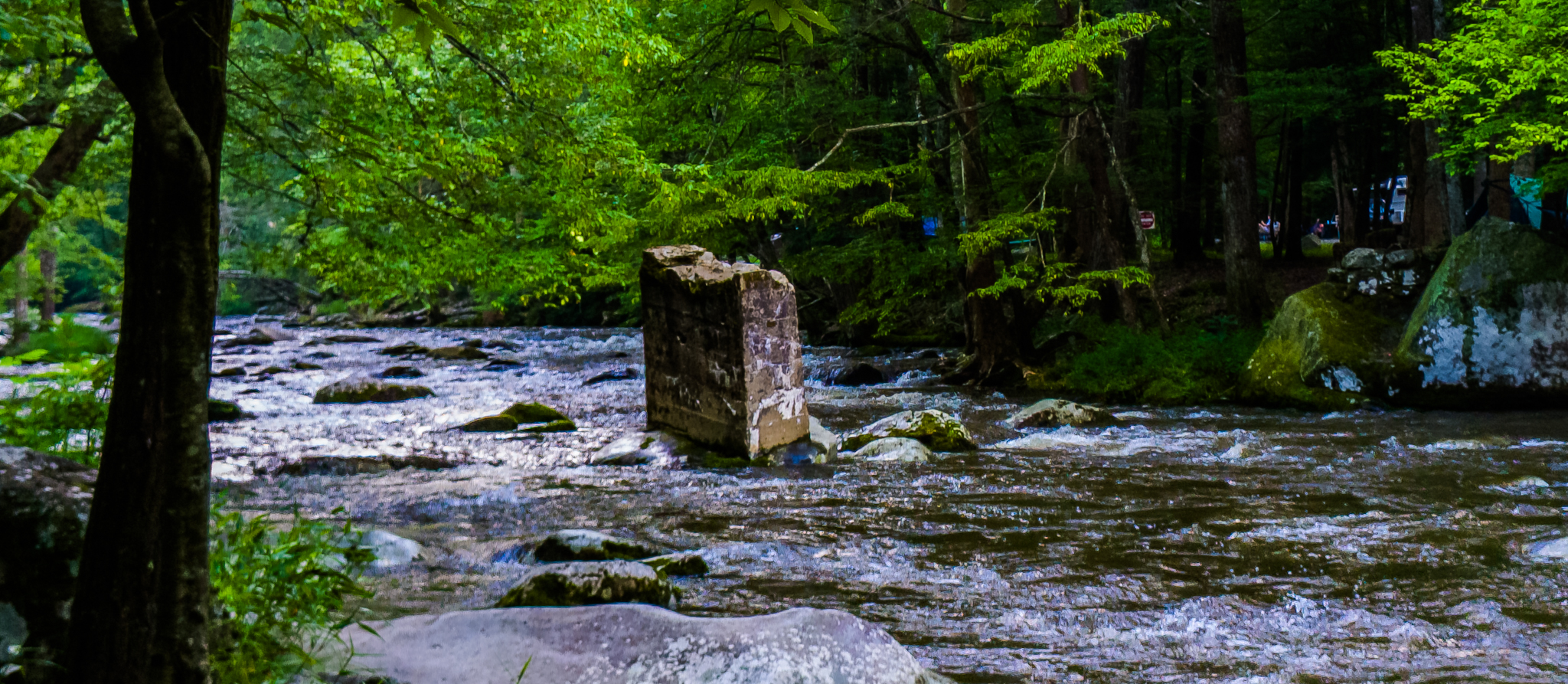
For two years, a chunk of old concrete sitting in a rushing Smoky Mountains river left me wondering about its history. It looked like the washed-out remains of a bridge for cars, but the truth is a lot heavier, both physically and emotionally. That decaying block is actually the scar of an environmental disaster. Even crazier, it’s a disaster that led to the creation of the national park itself.
An Almost Alien Landscape (At Least For Me)
Before I get to how I got curious about a block of concrete in a river, I want to first explain why I got into curious mode in the first place. Feel free to skip this section if you want to get to the answer!
Coming from the arid deserts of southern New Mexico, driving into the Great Smoky Mountains (or just about anything else east of about Dallas) is a total sensory shock. When you are used to the low chaparral (creosote bushes), the blowing sand, and the sharp, jagged peaks of the Southwest, the deep and overwhelming green of the Appalachians feels like stepping onto another planet. Sure, we have forests in the western US, but they’re small patches of trees restricted to the tops of the mountains, and even then, they’re not very lush or green on the forest floor.
My family always referred to the eastern US as “Back East.” When you grow up in the West, you tend to view the East Coast as the place where all the old US and much of our older family history lives. You have to go somewhere older to truly go back. But when you drive into the Smokies, you aren’t just going back to the pioneer days. You can actually feel the deep geologic age of the mountains. They are rounded and worn down by millions of years of rain and wind. Even the plants and the rivers somehow feel much older (and they are!).
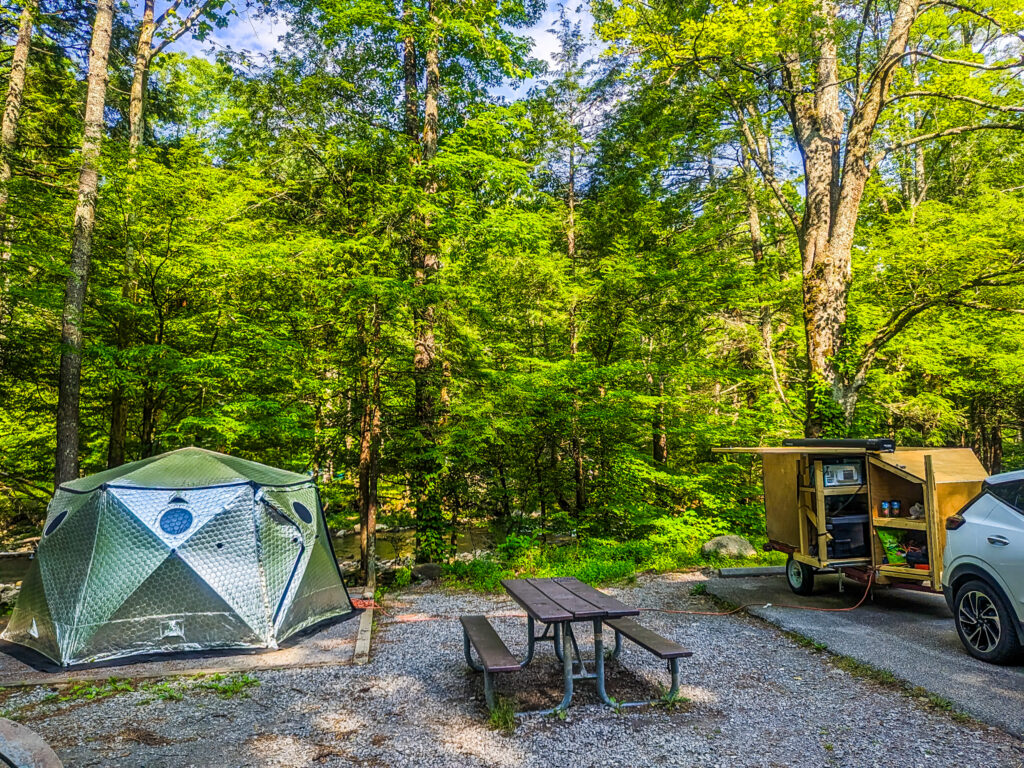
Add on top of this my slow trip getting there. On my first trip to stay overnight in the Smokies, I was towing a little trailer with my Chevy Bolt EUV. You can dig through the CleanTechnica archives to find the full details of how that towing adventure went, but I can tell you that dragging a camper across the Great Plains and into the humid South with an EV that wasn’t built for towing takes some serious patience. By the time I navigated the winding mountain roads and finally parked that rig under the thick canopy of Elkmont Campground, it felt like I had gone on a long, long journey.
I know this will sound a little silly, but between the new landscapes, the history and age of the place, and the hard trip getting there, I felt like an explorer. I was exploring basically the #1 national park that gets millions of visitors every year, but for me at least, it felt new and exciting enough that I was looking at all of the little details.
The Block of Concrete That Caught My Eye
After getting the campsite set up and plugged in, I took a walk along the banks of the Little River. I just wanted to stretch my legs and take in the refreshing chill of the water.
(Again, feel free to skip this section if you don’t find my story interesting!)
The roaring sound of the river rushing over the rocks reminded me a lot of the Gila River back home, or maybe the hidden creeks tucked away in Cave Creek Canyon in the Chiricahuas. But, the energy was completely different from mountain rivers in New Mexico like the upper Rio Peñasco. Out West, water always feels like it is fighting a losing battle against the dry air. It is a precious, fleeting thing that’s becoming more and more rare in recent years. Here in the Smokies, the water owned the entire landscape. It was dripping from the leaves, seeping out of the moss, and rushing over the smooth stones with absolute authority.
As I walked along the bank, something caught my eye. Right there in the middle of the fast water sat a massive, weathered block of concrete.
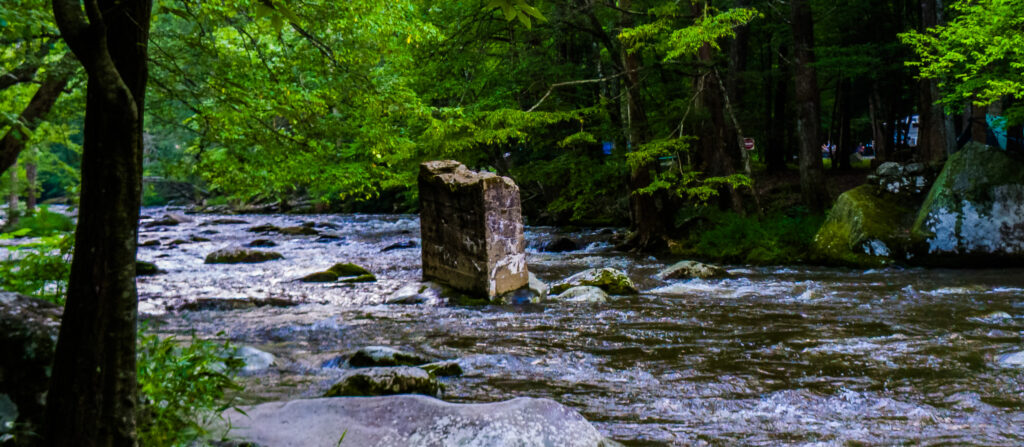
It looked completely out of place. It was a harsh, man-made rectangle sitting directly in the path of this pristine natural waterway, slowly collapsing and eroding into the river. My immediate thought was that it was just some old bridge for campers that washed out in a flood decades ago. Elkmont is a busy place, and it made sense that there used to be more infrastructure to help people get across the water.
But the sheer size of the thing made me second guess that idea. It was far too heavily engineered for a simple walking path, and it looked too narrow for a bridge that cars, trucks, and motorhomes would go across. It also seemed wrong for a mill or some other kind of water power infrastructure from the nineteenth century.
When I got back to the picnic table, I pulled out my phone and tried to look it up. I typed in every variation of “weird concrete block Little River Elkmont” I could think of. The internet gave me absolutely nothing useful. I found a bunch of campground reviews and a few fishing reports, but no explanation for the aging monolith sitting in the water. I use that word because I felt like the apes in 2001: A Space Odyssey. Had the water been warmer and if I had the right footwear, I might’ve gone out there to inspect it.
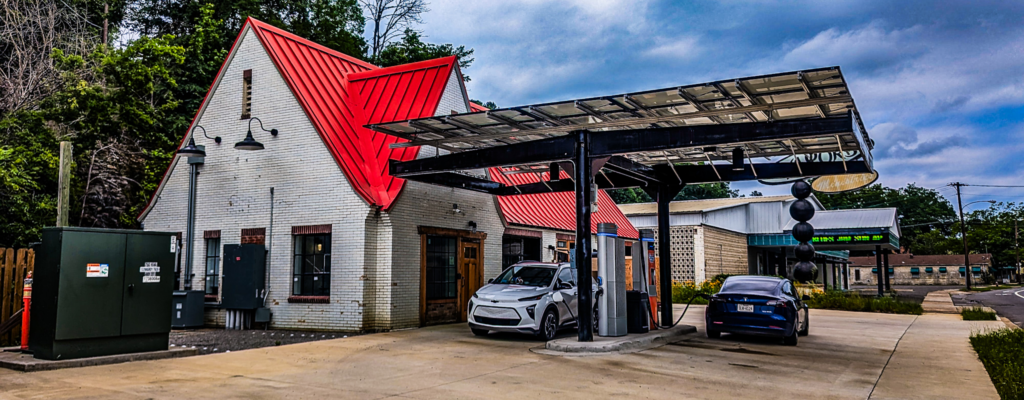
Eventually, the trip ended. I had to pack up the Bolt and head back to the desert. But that structure nagged at me. It became a weird, hyper-specific mystery that lived in the back of my mind for two whole years.
When I finally made it back for a second stay at Elkmont the following year, I knew exactly what I had to do. I walked straight back to that spot on the river. The block was still there, completely unchanged, still fighting the current. I made sure to snap a relatively clear, high-resolution picture of it so I could see if anyone on social media could identify it. Again, no dice. Nobody who saw it could tell me what it was.
In 2026, out of sheer desperation, I did something that many people on BlueSky would string me up for: I fed the picture into a chatbot to ask what the heck it was. Even without telling it where the picture was, it quickly identified the exact spot in the campground and told me what the block once held up. It also helped me to find a deeply interesting story of environmental disaster and rebirth into what would become Great Smoky Mountains National Park.
When Logging Ran Wild In The Smokies
It turns out that block of concrete is a ghost from the Little River Railroad. And the story behind it is one of the wildest ironies in American conservation history.
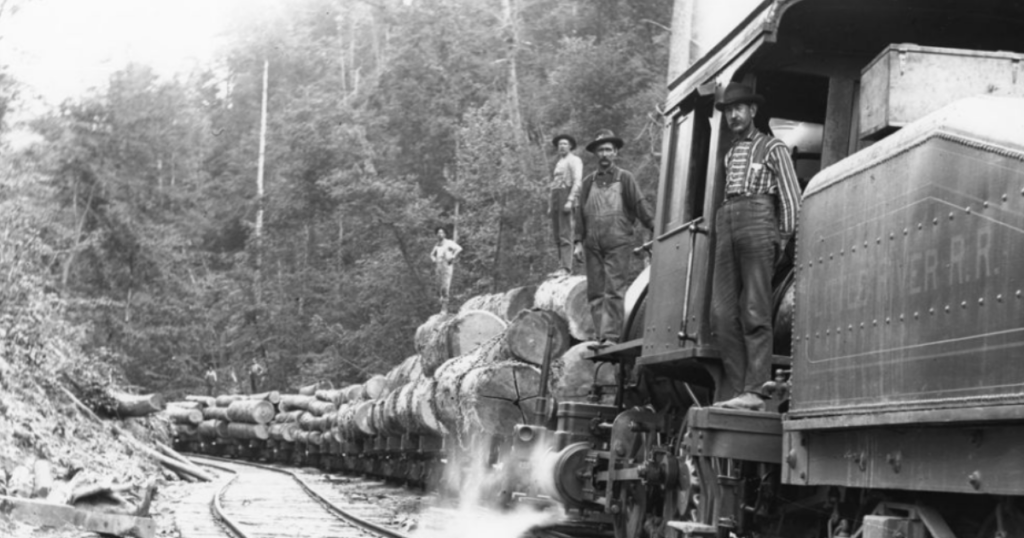
Back in 1901, long before the area was a protected national park, a businessman named W.B. Townsend (the nearby town is named after him) and a group of investors bought up nearly 100,000 acres of prime, seemingly untouched forest in the Smokies. They started the Little River Lumber Company and immediately got to work figuring out how to extract all that valuable timber from the rugged mountains.
Their solution was a massive engineering project. Over the next few decades, they laid down about 150 miles of standard-gauge railroad track right through the heart of the mountains. They used specially designed steam locomotives called Shay engines to muscle incredibly heavy loads of logs up steep grades and around super tight curves. These engines were geared differently than standard trains, allowing them to crawl up the mountainsides with unbelievable pulling power.
The concrete block I saw in the river wasn’t a footbridge or something people once drove their cars over. It was a heavy-duty bridge pier built to support the massive weight of those trains loaded down with giant old-growth trees that native Americans had been managing for millennia before they had been violently run out of the area with guns and European diseases.
The logging operation was brutally efficient. They didn’t just selectively cut trees. They used steam-powered skidders to drag the massive logs up and down the mountainsides, completely tearing up the soil and destroying everything in their path. By the time they finished, the company had cut down an estimated 560 million board feet of timber.
They clear-cut the mountainsides, leaving the landscape looking totally devastated. The ancient, dripping green forest I was standing in had once been reduced to a barren, muddy wasteland by the very people who built that concrete pier.
But Townsend wasn’t just making money on the logs. He realized that the railroad he built to destroy the forest could also be used to bring people into it. He started running passenger trains up the gorge, transforming Elkmont from a rough logging camp into a resort destination for wealthy families from Knoxville who wanted to escape the summer heat. He essentially built a tourism industry right alongside the clear-cutting operation.
This Backfired, Spectacularly
As you can probably imagine, the clear-cutting caused terrible erosion and totally wrecked the local ecosystem. It was so bad, and so visibly destructive, that it sparked a massive public outcry. People visiting these resort communities, along with locals and conservationists, were furious that this ancient landscape was being fed into a wood chipper for profit. The sheer scale of the destruction caused by the Little River Lumber Company is a huge part of what motivated citizens to push the federal government to protect the area.
That outrage ultimately led to the creation of the Great Smoky Mountains National Park. The environmental disaster caused by the railroad is the exact reason the park exists today.
When the state finally bought the land for the national park, they had to negotiate with the timber companies. They cut a deal that let the lumber company finish out their remaining logging operations. By 1939, the company finally shut down. They pulled up all the valuable steel tracks, packed up their equipment, and left. The only things left behind were the heavy concrete bridge supports sitting in the river.
Today, the forest has completely swallowed up the old logging operations. Walking through Elkmont, you would never guess that it was once the epicenter of a massive industrial clear-cutting operation. The trees grew back, the underbrush took over, and nature slowly erased the 150 miles of track. Just as many European settlers once though the area was “pristine and untouched” after decades of disease had stopped indigenous management, today it’s hard to see the scars as old growth forest takes hold once again.
That concrete block in the Little River is one of the only visible reminders of what happened there. It is a striking visual representation of why we charge out to these parks in the first place. The earth has an incredible, stubborn ability to heal itself, but only if we step back and give it the space to do it. Now, the river slowly breaks the concrete down. In a few hundred years, even that last scar will heal.
The ruins of the destruction literally became the birthplace of the preservation. It just goes to show that sometimes, the most beautiful and protected places we have were born out of a realization that we were about to lose them forever.
Next time you are walking along a river in a national park and see something that doesn’t quite belong, take a picture of it. You might just be looking at the reason the park was saved in the first place.
Share this:

Discover more from Charge To The Parks
Subscribe to get the latest posts sent to your email.
Wonderful story, Jenn. I didn’t know this history at all. Now to fix my Word Press account; this is Matt Fulkerson.